Breast Cancer and HRT
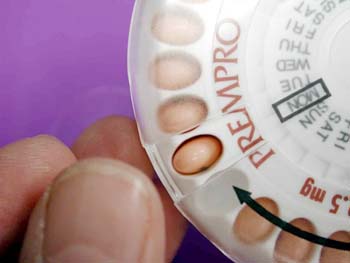
Immediately after my treatment for breast cancer, I manifested all the symptoms of an early menopause – hot flushes and all. Thankfully, it proved to be temporary for me, lasting about 8 or 9 months, but it certainly gave me a foretaste of what I can look forward to when the real menopause hits me. I am not sure how I will handle it, but one thing I do know for sure, is that it won’t be through the use of HRT.
Over the last 10 years research has provided a growing body of evidence that HRT can increase the risk of breast cancer, along with endometrial and ovarian cancer. In the over the past decade, it is estimated that 20,000 extra breast cancer cases have occurred among women aged 50-64 as a result of using HRT.
There are three different types of HRT available – oestrogen only, an oestrogen-progestagen combination and a synthetic form of oestrogen called tibolone. All forms of HRT increase breast cancer risk but the level of risk depends on which type a woman uses.
Combined oestrogen-progestagen HRT increases the risk of breast cancer much more than the other types. Around three-quarters (15,000) of the additional breast cancers are believed to be the result of using oestrogen-progestagen HRT.
Women using combined HRT have double the risk of breast cancer compared to women who do not use HRT at all. Those who use HRT for more than10 years increase their risk even more so the longer a woman uses HRT the greater the increase in her risk.
There is good news though. Breast cancer risk quickly goes back to normal when women stop taking HRT. Research shows that the effects of HRT on the breast are rapidly reversible.
Women deserted HRT in their droves after research from the Women’s Health Initiative study in the and the Million Women Study in the found that using hormone therapy could increase breast cancer risk.
Breast cancer rates among women in their 50s are falling at the same time as the number of women under 60 receiving prescriptions for HRT has halved – according to Cancer Research. In 2000 more than 40 per cent of women aged 50-54 were taking HRT and the figure was more than 35 per cent in the 55-59 age group.
But by 2006 HRT users among 50-54 year olds had plummeted to around 20 per cent and among 55-59 year olds the percentage dropped to just 15 per cent according to a new report published recently in the European Journal of Cancer.
Professor Max Parkin, a Cancer Research UK statistician based at Queen Mary College, University of London said: “Between 1996 and 2000 we can estimate that HRT use was responsible for an additional breast cancer risk of around 30 per cent to UK women in their 50s.
“We cannot be absolutely sure that the drop in both breast cancer rates and breast cancer risk is the direct result of women giving up HRT. But the parallel is striking and it will be interesting to see if this decline continues over the next few years.”
It can be a difficult balancing act deciding whether to take HRT. Symptoms can be so severe that they need medication. But that medication can increase the risk of cancer, and not just breast cancer.
Cancer Research ’s advice remains the same: women should only take HRT for medical reasons and for as short a time as possible.
Source: Cancer Research UK via Primary Care Today website


