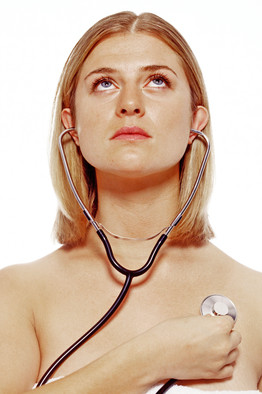
Do you know what your body is telling you?
Getty Images
As cancer survivors, I reckon we are all very tuned into what our bodies are telling us. Perhaps too tuned in at times, when every slight ache and twinge can lead to fears of a recurrence.
Reading Melinda Beck, the Wall Street Journal’s health correspondent, I learned of even more signs than I was aware of before! Did you know that eyebrows that no longer extend over the corners of the eyes can indicate an underactive thyroid, and a diagonal crease in the earlobe seems to herald a heightened risk of heart attack?
Beck maintains that for the majority of people, many of don’t recognize the warning signs of illness, even when they’re staring us in the face. Medical writer Joan Liebmann-Smith was losing weight rapidly. Her hair was falling out. Her heart was racing, and she couldn’t sleep. She chalked up her symptoms to the stress of having a new baby, while a psychiatrist she consulted for insomnia told her to just “count sheep.”
Over lunch one day, a relative looked at her bulging eyes and the big lump in her throat and said, “Joan — you have a goiter!” A blood test confirmed that she had an advanced case of Grave’s disease, an autoimmune disorder that causes the thyroid gland to swell and produce too much of the powerful hormone.
“I had all the classic signs, and I ignored them,” says Ms. Liebmann-Smith, a medical writer, who resolved to write a guide for laymen to the warning signs of serious illnesses. “Body Signs” — written with Jacqueline Nardi Egan, a breast-cancer survivor — came out in 2007 and has since been published in 26 countries.
“We don’t want people to panic and jump to conclusions,” Ms. Liebmann-Smith says. “But it’s important to pay attention to your body. Knowledge is power.”
But many doctors and nurses alike say that patients, too, should be vigilant for anything new or unusual about their own bodies. “The more engaged patients can be, the better,” says Ted Epperly, president of the American Academy of Family Physicians, who maintains a practice in Boise, Idaho. With major changes to the nation’s health-care system looming, it may be more important than ever for people to keep track of their own physical health. Primary-care doctors could become increasingly pressed for time, and long-term doctor-patient relationships may be harder to sustain. The growing emphasis on preventive medicine may also place more responsibility on patients to head off illnesses before they become serious.
Once again, the emphasis is firmly placed on how important it us for us all to take responsibility for our health. As I have said many times before, your life truly is in your hands.
Read the rest of Melinda Beck’s article here


You are so right! I am a big advocate of patient empowerment too! Well done on the blog 🙂
LikeLike
Yes, most important that we take responsibility for our own health.
LikeLike
Just wanted to let you know how much I am enjoying your blog. I have been following you for a while now and your posts are always informative and thought provoking. Thanks for all you do.
LikeLike
Easily, this Treating Panic Attacks article is really the most informative on this deserving topic. I agree with your conclusions and am eagerly look forward to your future updates. Just saying thanks will not just be enough, for the extraordinary clarity in your views and writing. I’m signing up to
LikeLike